Pump Selection for Industrial Systems: Pulsations, Noise and Flow Continuity – Why Install a Screw Pump?
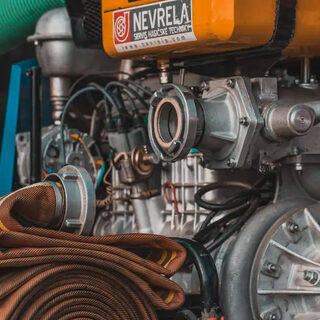
When discussing production continuity in industrial systems, attention often focuses on automation, sensors, software and predictive maintenance. All of these are important. But before analysing the data, there is a more fundamental question: is the fluid being delivered correctly, at the required flow rate and in a way that is consistent with the machine's operating cycle?
In many hydraulic and lubrication systems, the answer also depends on the pump.
Selecting a pump that is not suitable for the application can result in pulsations, excessive noise, vibrations, flow irregularities and unexpected mechanical stress on downstream components.
The objective is not to select the "best pump" in absolute terms. It is to identify the pump that best meets the application's requirements: operating pressure, flow rate, fluid characteristics, flow continuity, installation dimensions, acceptable noise levels, circuit configuration, operating conditions and maintenance requirements.
Why Pump Selection Affects Overall System Performance
A pump is not an isolated component. It is one of the elements that determine the dynamic behaviour of the entire hydraulic circuit.
If the flow is irregular, pulsations are excessive or noise levels increase beyond expectations, the effects may extend to pipes, valves, filters, actuators, heat exchangers, accumulators and monitoring instruments.
In a real hydraulic circuit, flow rate and pressure are not merely theoretical parameters.
They affect machine cycle times, motion stability, component loading, workplace noise levels, maintenance requirements and the perceived reliability of the equipment.
For this reason, pump selection should begin with the process requirements rather than the product catalogue.
The first step is to define what the circuit needs to achieve. Only then should the most appropriate pump technology be evaluated.
Pulsations: What Happens When Flow Is Not Stable?
Pulsations are periodic variations in flow rate or pressure generated by pump operation and its interaction with the hydraulic circuit.
In some applications, these variations are acceptable. In others, they become a problem because they can increase vibration, noise and mechanical stress.
When fluid flow is irregular, system behaviour may become less stable.
An actuator may exhibit slight movement irregularities, a valve may operate under less favourable conditions, a pipeline may vibrate or a component may be subjected to more intensive cyclic loading.
It would be incorrect to claim that selecting a particular pump technology can eliminate all pulsations.
Every hydraulic circuit has its own dynamic characteristics.
However, when an application requires particularly smooth and consistent flow, screw pumps and helical rotor pumps deserve careful consideration.These technologies are designed to reduce flow pulsations and discontinuities compared with other pump types that may be better suited to different operating requirements.
Noise and Vibrations: More Than Just Workplace Comfort
Pump noise is often considered primarily a matter of workplace comfort.
In reality, in many industrial environments, noise can also provide an indication of how the hydraulic circuit is operating.
A noisy machine may be functioning correctly, but excessive noise can also indicate suboptimal operating conditions, such as cavitation, incorrect installation, unsuitable fluid characteristics, inappropriate rotational speed, excessive pulsations or a pump technology that is not well matched to the application.
Reducing noise is therefore not simply about creating a more comfortable working environment.
It can also help limit vibration, improve circuit stability, simplify fault diagnosis and enhance overall system performance.
Screw pumps are frequently considered when an application requires continuous flow and low noise levels.
This does not make them a universal solution, but it makes them particularly relevant for lubrication circuits, hydraulic systems and industrial applications where smooth fluid delivery and quiet operation are important performance requirements.
When Does It Make Sense to Choose a Screw Pump?
A screw pump can be an appropriate choice when an application requires continuous flow, low pulsation levels, smooth operation and reduced noise.
These requirements are common in lubrication circuits, industrial installations, machine tools, oil circulation systems and applications where fluid flow stability directly affects machine operation.
However, the benefits should not be described in generic terms.
It would be inaccurate to suggest that a screw pump is always superior to a gear pump, vane pump or piston pump.Each pumping technology has its own operating characteristics and application range.
The key is to identify the dominant requirement of the system: pressure, compact dimensions, flow rate, noise reduction, flow stability, efficiency or durability under demanding operating conditions.
The Comer range of screw pumps and piston pumps allows these considerations to be applied to specific industrial requirements.
In particular, certain screw pump and helical rotor pump solutions are designed for industrial applications requiring long service life, smooth flow, low noise emissions and reduced pulsations.
Screw Pumps vs. Piston Pumps: Different Technologies for Different Requirements
A common mistake is comparing pumps as though all technologies were interchangeable.
In reality, screw pumps and piston pumps are designed to meet different operating requirements.
Screw pumps are particularly relevant when smooth flow, continuous delivery and low pulsation levels are priorities.Piston pumps may be more suitable for applications involving high operating pressures, demanding duty cycles or conditions where durability and volumetric efficiency are particularly important.This means pump selection should not begin with questions such as "Which pump is cheaper?" or "Which pump is most commonly used?"
Instead, the starting point should be: How must the hydraulic circuit perform under actual operating conditions?
If a system requires low noise and a consistent flow rate, the selection criteria will differ from those of an application requiring very high pressures or particularly demanding operating cycles.
Retrofit and Pump Replacement: Avoid Oversimplifying the Process
Many industrial projects do not involve designing a completely new system.
Instead, they begin with an existing machine, a hydraulic circuit that operates but generates excessive noise, a production line affected by recurring vibrations or a pumping unit requiring greater flow stability.
In these situations, replacing the existing pump with a different technology may be considered.
However, this requires careful technical evaluation.
A pump cannot be replaced simply by comparing nominal flow rate and pressure specifications.
Several other factors must be assessed, including connection types, installation dimensions, fluid viscosity, rotational speed, pressure losses, suction conditions, circuit compatibility and control logic.
Some pump families are also designed to facilitate the replacement of technologies characterised by higher noise levels or greater flow pulsations.
Nevertheless, retrofitting remains an engineering task that must be evaluated according to the actual installation.
Universal compatibility should never be assumed or guaranteed without a proper technical assessment.
Practical Criteria for Selecting an Industrial Pump
Selecting the right pump begins with a series of practical operating questions.
What type of fluid needs to be pumped?
What is its viscosity under actual operating conditions?
What flow rate is required, and how continuously must it be delivered?
What are the maximum pressure and normal operating pressure?
Is noise reduction an important design requirement?
Could flow pulsations interfere with machine operation?
Is the available installation space limited?
Does the circuit operate continuously or intermittently?
Are there demanding temperature, load or environmental conditions?
Answering these questions helps avoid two opposite mistakes.
The first is unnecessarily oversizing the pump as a precaution, increasing costs and system complexity.
The second is selecting a pump that appears suitable based on nominal specifications but does not adequately match the actual dynamic behaviour of the hydraulic circuit.
Common Mistakes to Avoid
The first mistake is considering only the nominal flow rate.
Two pumps with similar nominal flow rates may behave very differently in terms of pulsations, noise and operating stability.
The second mistake is overlooking suction conditions.
Even a correctly selected pump can operate outside its intended conditions if the suction supply is inadequate, potentially causing noise, cavitation or premature wear.
The third mistake is treating noise as a secondary parameter.
In some industrial installations, noise is an important design constraint, particularly when machines and operators share the same working environment.
The fourth mistake is selecting a familiar pump technology without verifying whether it is still suitable for the application.
Changes in machine operating cycles, fluid characteristics or maintenance objectives may require a different technical solution.
The fifth mistake is making absolute performance claims.
A pump alone cannot guarantee zero vibration, zero noise or zero downtime.
However, when correctly selected and integrated, it can contribute to a more stable and reliable industrial system.
Conclusion
Pump selection is not simply a purchasing decision.
It is an engineering choice that directly influences system performance, including flow rate, pressure, noise, vibration, maintenance requirements and operational continuity.
In an industrial environment increasingly focused on data analysis, downtime reduction and predictive maintenance, mechanical components remain fundamental.
Before relying on software to interpret an operating anomaly, it is important to minimise the technical causes that may generate it.
Screw pumps, helical rotor pumps and piston pumps should not be presented as interchangeable solutions.
They should be selected according to the actual application requirements: smooth flow, low pulsations, high pressure, installation dimensions, noise levels, service life and operating conditions.
When the pump is properly matched to the application, the hydraulic circuit becomes easier to understand and monitor.
And a system whose operating behaviour is easier to interpret is also easier to control, maintain and improve.